


The article critiques prolonged pre-trial detention, selective bail through role-based hierarchies, and expansive security-law interpretations. It argues that delayed trials and elastic definitions of terrorism erode personal liberty, weaken the presumption of innocence, and shrink democratic space, urging a constitutional rebalancing in criminal justice.
I. Bail as the Rule, Liberty as the Core
The recent judicial decisions in the Delhi riots conspiracy case raise serious constitutional and legal questions that go far beyond the fate of individual accused. At the centre of the debate lies a long-standing principle of criminal justice: personal liberty is the norm, and deprivation of liberty before conviction must remain an exception. When individuals spend years in prison without a trial reaching even the stage of framing charges, the justice system is compelled to examine whether procedure itself has become punishment.
The denial of bail to two accused, despite the passage of more than five years since their arrest, underscores the growing tension between statutory stringency and constitutional guarantees. Laws dealing with national security undoubtedly permit stricter thresholds, yet they were never meant to legitimise indefinite incarceration. Prolonged pre-trial detention tests the very meaning of the right to life and personal liberty. When courts acknowledge that incarceration is “substantial” but still insufficient to trigger constitutional concern, liberty begins to appear conditional rather than inherent.
Equally troubling is the notion that time alone may not be decisive unless it crosses an undefined constitutional threshold. This creates uncertainty and inconsistency, leaving accused persons trapped in a cycle of repeated bail applications with no clear end in sight. In a system burdened by delays, the promise of a future opportunity for relief offers little reassurance. Justice delayed does not merely become justice denied; it transforms into a systemic failure where freedom depends on endurance rather than rights.
The partial grant of bail to some accused affirms, at least in principle, that endless incarceration is unacceptable. However, selective relief also exposes the fragility of liberty when weighed against prosecutorial claims under stringent laws. The core concern is not only who is released, but why others remain detained despite similar procedural delays. This selective approach risks undermining the universality of constitutional protection.
II. The Construction of Hierarchies and the Risk of Prejudgment
A defining feature of the decisions is the creation of a “hierarchy of participation” among the accused. By categorising individuals as principal planners on one end and peripheral facilitators on the other, the court sought to justify differential treatment at the stage of bail. While individual assessment of culpability is a legitimate judicial exercise, the timing and method of this assessment are deeply consequential.
Bail hearings are meant to be limited inquiries, not substitutes for full trials. When courts begin to classify accused persons based on perceived ideological influence, conceptual leadership, or alleged orchestration, they risk stepping into the domain of final adjudication. Such classifications rely heavily on the prosecution’s narrative, which has yet to be tested through cross-examination or judicial scrutiny of evidence.
This approach carries the danger of prejudgment. Once an accused is labelled as occupying a higher rung in an alleged conspiracy, that characterisation may follow them throughout the legal process, shaping perceptions at every subsequent stage. The presumption of innocence weakens when judicial language implies centrality or masterminding before guilt is established.
Moreover, the idea of a hierarchy introduces subjectivity into bail jurisprudence. Political expression, organisational ability, or prominence in public discourse may be misconstrued as criminal leadership. In cases arising from protests or mass movements, those who articulate dissent or mobilise opinion may face harsher treatment not because of proven violent acts, but because of their perceived influence. This creates a chilling precedent where visibility itself becomes a liability.
Parity among accused is a cornerstone of fairness. Departures from parity demand compelling and clearly demonstrable reasons. When distinctions are drawn prematurely, without the benefit of a completed trial, they risk appearing arbitrary. Justice must not only be done but must be seen to be done, and selective incarceration based on untested hierarchies erodes public confidence in the neutrality of the legal process.
III. Expanding Terror and Shrinking Democratic Space
Perhaps the most far-reaching implication of the case lies in the interpretation of what constitutes a terrorist act. Anti-terror legislation was enacted to address extraordinary violence that threatens the nation’s security and integrity. Over time, however, the scope of such laws has expanded through broad statutory language and expansive interpretation.
Activities such as organising protests, coordinating through messaging platforms, and enforcing road blockades have been treated as potential components of terrorist conduct when viewed through the lens of intent and coordination. This interpretive expansion blurs the distinction between violent extremism and civil disobedience. While public order disruptions may warrant legal response, equating them with terrorism fundamentally alters the relationship between the State and citizens.
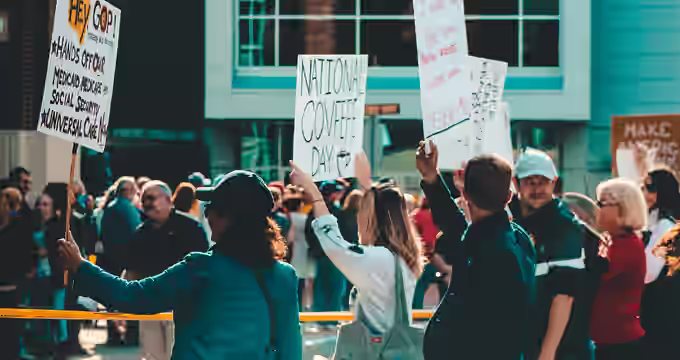
Democratic societies rely on the right to dissent, assemble, and protest. These activities are often disruptive by nature, challenging authority and unsettling the status quo. Addressing them through ordinary criminal law preserves proportionality and accountability. Invoking extraordinary statutes with severe procedural consequences transforms dissent into an existential threat, inviting excessive State power.
The chilling effect of such an approach cannot be overstated. When protest carries the risk of being labelled terror, citizens may retreat from public engagement altogether. The fear of prolonged detention, limited bail, and drawn-out trials discourages participation and silences opposition. Democracyeth and digital organisation, now integral to collective action, become suspect by default.
Equally concerning is the imbalance of power embedded in stringent security laws. The State’s ability to arrest and detain is vast, while avenues for timely relief are narrow. In such circumstances, judicial oversight becomes the primary safeguard against misuse. When courts accept broad and loose framings of terror-related conduct, that safeguard weakens, allowing exceptional measures to become routine.
The comparison between acts involving mass casualties and protest-related allegations highlights a problem of proportionality. Laws designed in response to extreme violence lose moral and legal clarity when applied to fundamentally different contexts. This dilution harms both the fight against genuine terrorism and the protection of civil liberties.